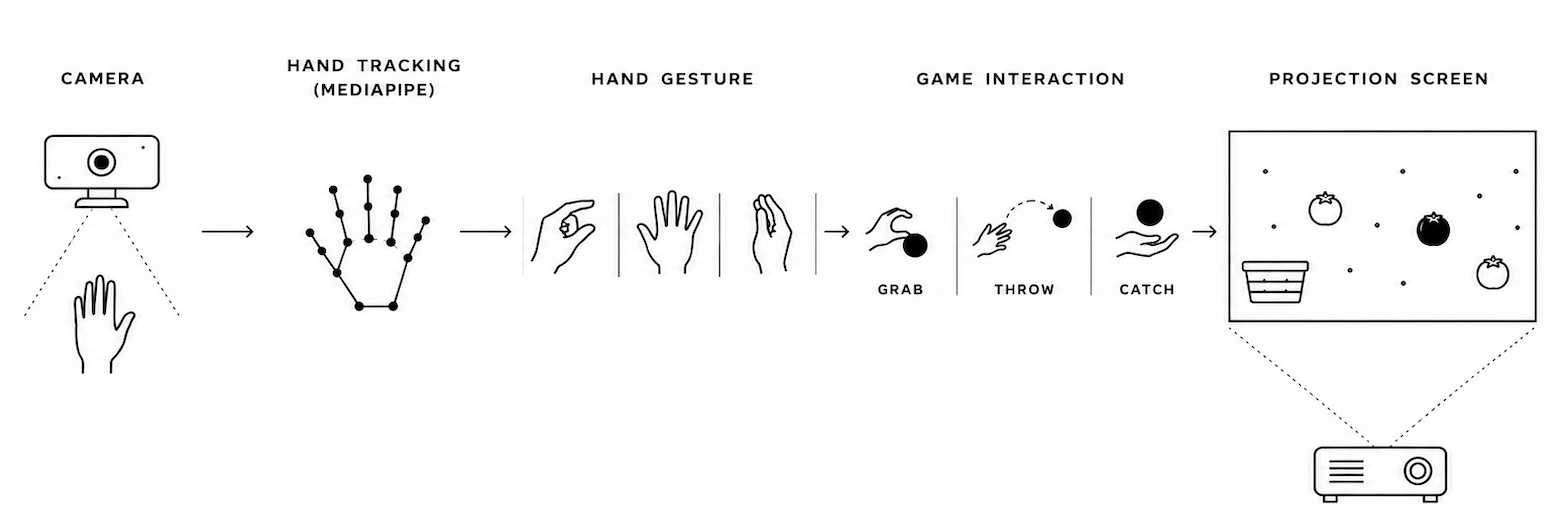
Rehand explores how rehabilitation exercises can become something people genuinely want to repeat. Instead of treating therapy as a series of repetitive tasks, the project transforms common hand exercises into playful interactions. Using motion tracking and projection, physical movement becomes part of the game itself, encouraging rehabilitation through curiosity, movement, and play.
Hand rehabilitation often relies on repetitive exercises that can become frustrating and difficult to stay motivated with over time. The goal was to explore whether game mechanics could encourage repetition without making the experience feel clinical.
The experience was designed around rehabilitation movements before gameplay. Common exercises, such as gripping and pinching, became the foundation for every interaction, allowing therapeutic movements to naturally drive the game.
A projector displays the game while a camera tracks hand movements in real time using MediaPipe. Each gesture controls an action on screen, turning physical therapy into a playful interactive experience.
Rather than designing a traditional rehabilitation tool, the focus was on creating an experience people would enjoy returning to. Every interaction was designed to feel immediate, intuitive, and rewarding, encouraging repetition through play rather than obligation.
Rehand demonstrates how interaction design can shift rehabilitation from routine exercise to playful participation, exploring how physical movement and game mechanics can support long-term engagement.